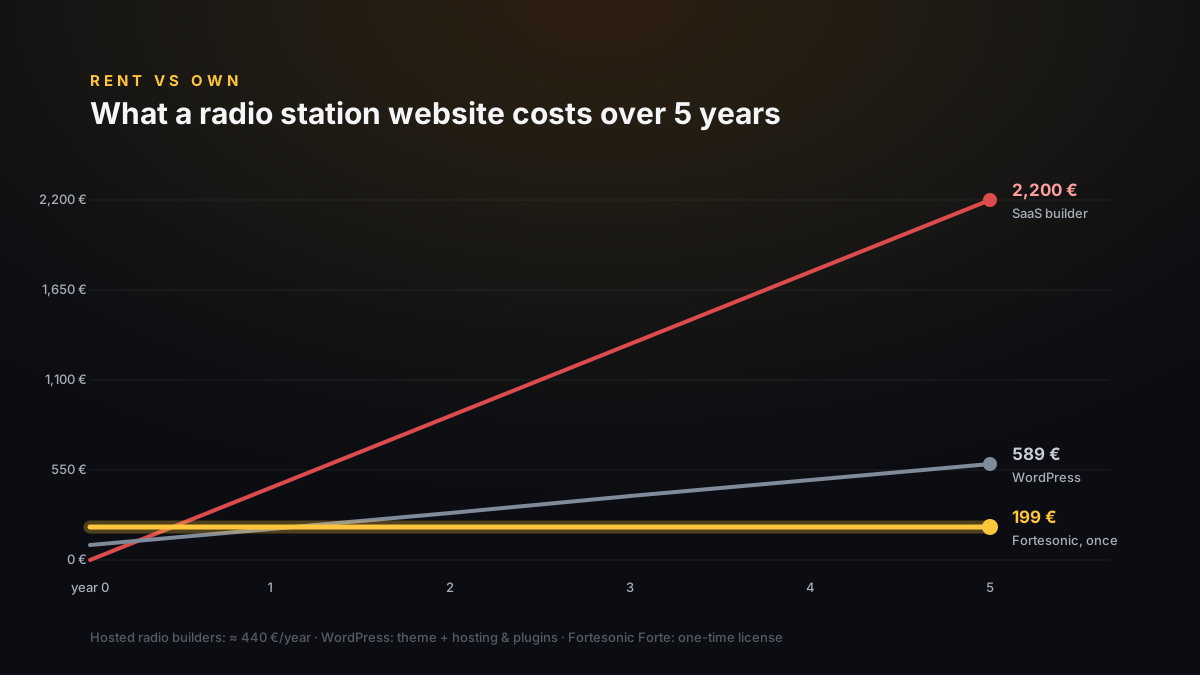
You already pay for streaming. Then the website industry shows up with its hand out: 440 € or more, every single year, for a template page on somebody else's platform. Stop paying, and your station's web presence vanishes overnight. There is a better way to do this — and the math isn't even close.
If you run an internet radio station, you have exactly three realistic options for a proper listener-facing website: rent one from a hosted SaaS radio website builder, assemble one from a WordPress radio theme, or own one outright with a self-hosted platform like Fortesonic. We build the third option, so yes — we have a horse in this race. That's why everything below is numbers-first: check them, question them, recalculate them yourself.
Rent vs. own: run the numbers yourself
Hosted builders price themselves per month, which sounds harmless. Nobody buys a website for one month. Websites live for years — so that's how we should compare. Pick a horizon:
Total cost of your radio website
Over 5 years you keep 2,001 € in your pocket compared to renting from a SaaS builder.
Reference points, July 2026: hosted radio website builders run roughly 440–490 € per year for the website layer alone, before streaming plans. WordPress estimate: one-time theme (59–119 €) plus typical hosting and plugin renewals. Fortesonic Forte is a one-time 199 € license; updates renewal after year one is optional (59 €/year) and your site keeps working without it.
That's the whole argument, honestly. Everything else in this article is detail. A SaaS builder isn't selling you a website — it's selling you a subscription to your own audience. The longer your station lives, the worse the deal gets.
A hosted builder isn't selling you a website. It's renting you access to your own listeners — and the rent never ends.
What renting really costs you (beyond the money)
The subscription fee is the visible price. The invisible price is bigger:
Your domain is a facade
Many hosted builders serve your "site" from their infrastructure. The SEO authority you build over years is tied to their platform — and it stays with them if you leave.
The price only moves up
You're locked in. Migrating a live station's website is painful, and platforms know it. Annual price increases are the business model.
Their roadmap, not yours
Need a feature? File a request and wait. On a platform you rent, you customize only what the platform decides is customizable.
Stop paying = go dark
Miss a renewal and your station's web presence is gone — links dead, player dead, listeners staring at a suspension page.
"Fine, I'll just use WordPress" — the hidden stack
WordPress radio themes look like the budget option: 59–119 € for the theme and you own it. True — but look at what you now operate:
- A MySQL database that needs backups, for a site that is essentially one page and a stream.
- A plugin stack — players, caching, security, SEO — each with its own updates, conflicts and renewal fees.
- A permanent update treadmill. WordPress core, PHP compatibility, theme updates, plugin updates — skip a few months and you're a security statistic.
- Weight. Page builders and jQuery-era themes ship megabytes of machinery to render a play button.
None of that is evil — WordPress is a fine CMS. It's just the wrong tool for a radio station's listener page. You don't need a content management system; you need a product-grade player experience that reads your AzuraCast API and stays out of your way — on an architecture with no database to maintain or breach.
The third option: own the whole thing
Fortesonic is a self-hosted radio website platform, engineered as clean PHP and vanilla JavaScript. One FTP upload, one config file, and your AzuraCast stream has a premium website on your domain, your server, your rules — installable as a PWA, with live metadata, broadcast history, song requests and TV mode. No database. No plugin stack. No monthly fees.
And because the license is perpetual, the worst-case scenario reads like this: you never pay us again, and your website keeps working. Compare that with the worst case above.
Side by side
Same table we show on the home page — pick your opponent:
| Criteria | Fortesonic | SaaS website builders | WordPress radio themes |
|---|---|---|---|
| Cost | 99–199 € once | 440 €+ every year | 59–119 € + hosting & plugins |
| Your own domain & server | Yes | Their platform, their rules | Yes |
| Works with AzuraCast | Built for it | Usually locked to their streams | Varies by theme |
| Database required | None | Hidden — their stack | MySQL + WordPress stack |
| Installable PWA | Yes, iOS & Android | Rarely | Rarely |
| If you stop paying | Keeps working forever | Site goes offline | Keeps working |
The honest objections
“But with SaaS I don't manage anything.” Fair. That's why the Fortissimo plan exists: the same white-label site on our managed NVMe server with SSL, CDN and automatic updates — 299 €/year, all-in, still cheaper than the big builders. And unlike them, you can step off onto your own hosting anytime, because it's the same product.
“Will it run on my cheap shared hosting?” Almost certainly: PHP 8+, HTTPS and cURL are the whole checklist — no database, no Node.js. There's a 14-day money-back guarantee if your hosting can't be made to work.
“I'm not technical.” Installation is an FTP upload and one config file — or add the 49 € installation service and we do it for you. The documentation is public; read it before you spend a cent.
The bottom line
A radio station is a long-term project. Websites priced per month quietly assume you won't do the multiplication — so do it: at five years, renting costs roughly ten times a one-time Fortesonic license. Own the player, own the domain, own the audience. That's the whole pitch.